Define the question
Agree the place challenge, intended learning and the decision that will follow the pilot.

THE OKLUS PILOT PROGRAMME
A structured route for councils and delivery partners to test relevance, responsibilities and public value before considering wider deployment.
PILOT BEFORE SCALE
The programme is designed to help a public body answer a defined local question, not to manufacture a positive result.
Each pilot would be shaped around route context, asset constraints, governance, maintenance, communication and evaluation. Claims remain proportionate to the evidence available, and future concepts are clearly separated from confirmed capability.
A SIX-PART FRAMEWORK
The framework creates review points before installation, during operation and at the end of the agreed period.
Agree the place challenge, intended learning and the decision that will follow the pilot.
Review existing assets, public use, access, technical constraints and local context.
Make ownership, installation, inspection, maintenance, communications and escalation clear.
Record the starting position and agree what evidence is proportionate and practical to collect.
Capture service activity, route observations, public feedback and any agreed environmental indicators.
Conclude whether to proceed, adapt, repeat or stop, with assumptions and limitations visible.
FOUNDING PILOT PROGRAMME
An illustrative first pilot could bring the product, engineering review, living-media configuration, operations and evaluation into one defined programme.
BIODIVERSITY-ENABLED PILOT OPTION
Where biodiversity habitat forms part of an agreed pilot, the research method could be strengthened with comparison locations, defined environmental fields and a biological outcome hierarchy.
Target species or groups, monitoring period, habitat geometry, lighting thresholds and biological methods would require ecological input. The JEB research informing these questions did not test OKLUS.
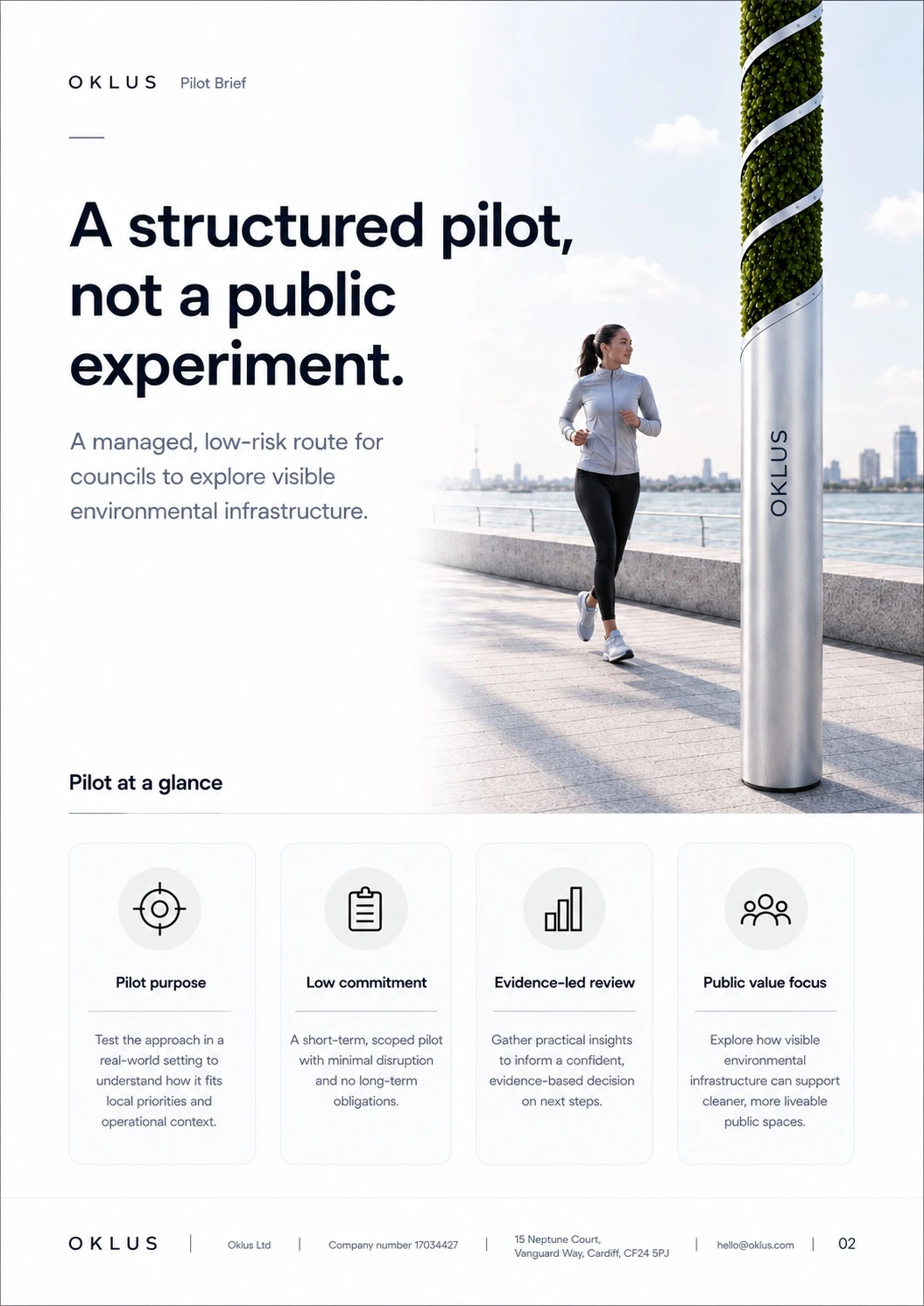
THE PILOT BOOKLET
The booklet introduces the proposition, pilot logic, governance principles and the questions that should be resolved before deployment.
Current materials are supplied for discussion and do not represent a procurement offer or guaranteed deployment outcome.
COUNCIL CONFIDENCE CHARTER
These principles guide how OKLUS proposes to communicate, structure and evaluate early public-realm activity.
WHAT A PILOT CAN AND CANNOT DO
A pilot can test operational fit, route relevance, maintenance logic, public understanding and the practicality of an evaluation method.
It cannot by itself prove universal impact, guarantee scale economics or remove the need for technical, legal and procurement review. Any environmental interpretation would depend on the agreed methodology, context and data quality.
Read the evidence approach ↗FROM INTEREST TO REVIEW
Progress is earned at each stage. A responsible outcome may be to refine the proposal or decide that a pilot is not appropriate.
Local priority, stakeholders and decision question.
Route, asset, governance and partner review.
Scope, responsibilities, baseline and review plan.
Installation, operation, maintenance and observations.
Findings, limitations, public value and next decision.

A PRACTICAL FIRST STEP
We will help explore whether a structured OKLUS pilot is relevant, what it would need to learn and where the uncertainties remain.