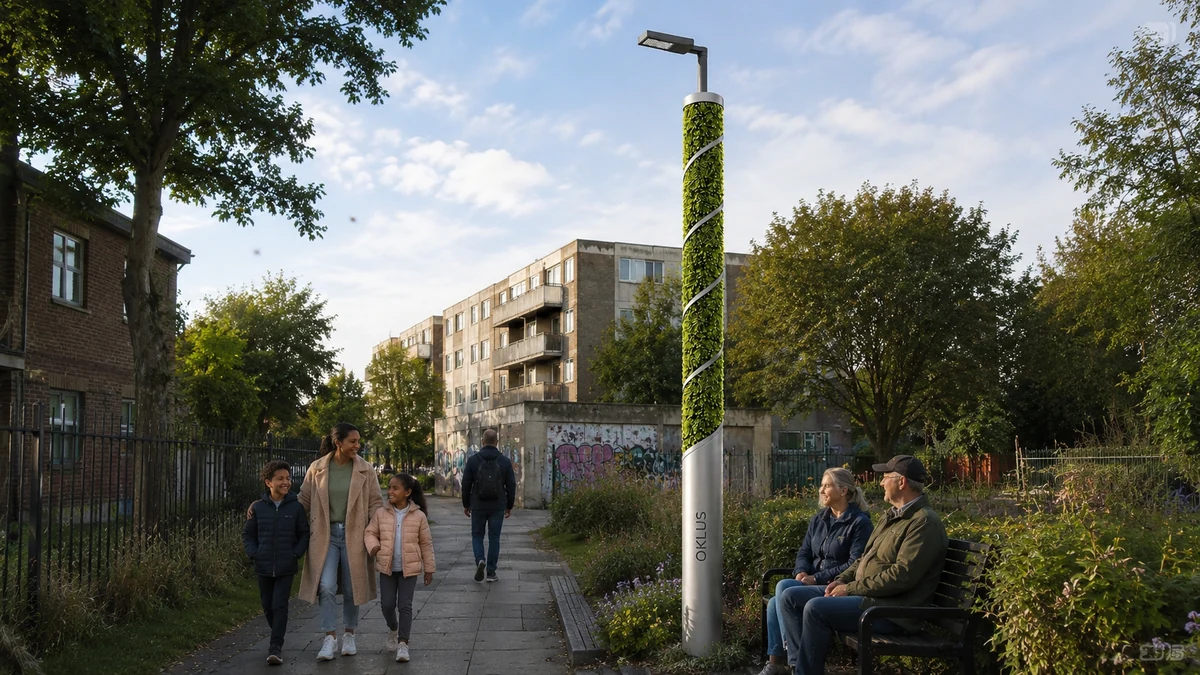
FOR COMMUNITIES
Infrastructure people can recognise, question and help shape.
OKLUS is being developed as a visible, serviceable retrofit proposition for everyday routes. Community pilots can help test where it feels relevant, how it should be explained and what responsible long-term care looks like.
PUBLIC VALUE BEGINS WITH RELEVANCE
A strong pilot should feel useful to the place, not imposed on it. Listen early. Explain clearly. Care visibly.
Community confidence is not a final communications task. It is part of product design, route selection, maintenance and evaluation from the beginning.
OKLUS community pilots are intended to create a practical setting for that work. Residents, local groups, schools, route users and delivery partners can help identify concerns, opportunities and measures of value before any wider deployment decision.
DESIGN AROUND EVERYDAY LIFE
Start with the journey, the people and the local rhythm.
A community route is more than a line on a map. It connects homes, schools, parks, shops, transport and shared spaces.
Before any installation, a pilot would examine who uses the route, when it is busiest, where people pause, what access constraints exist and how maintenance can happen without creating disruption.
Observe the routeMap movement, dwell points, accessibility, lighting assets, shade, servicing access and local character.
Invite local insightAsk residents and community organisations what feels important, unclear or unsuitable.
Shape the explanationAgree what information should be available on-street, online and through council channels.
Plan visible careSet inspection, living-media care, fault response and contact routes before launch.

08:10School and work journeysBusy crossings and predictable morning movement
13:20Community and park useSlower movement, seating and shared space
18:05Evening return routesLighting, confidence and maintenance visibility
FUTURE COMMUNITY-SUPPORT VIEW
One shared record of questions, actions and learning.
This illustrative workspace shows how a pilot team could connect local feedback with route observations, maintenance actions and decision records without presenting community opinion as a single score.
COMMUNITY PILOT WORKSPACENeighbourhood route 01
Illustrative concept only

LOCAL QUESTIONHow can the route feel greener while staying practical to maintain?Listening themes: access, appearance, care, information and route relevance
A SIX-STAGE COMMUNITY PILOT
Build confidence through decisions people can follow.
The process should make clear who decides, how local insight is used, what is being tested and how concerns will be answered.
Agree the local purpose
Define the route challenge, public-value questions, decision owners and limits of the pilot.
Gather different perspectives
Hear from route users, local groups, schools, businesses and people with access needs.
Test route suitability
Review columns, footway space, visibility, maintenance access, planting context and planned works.
Publish the pilot promise
Set out what will happen, who is responsible, how information is used and how to raise an issue.
Operate with open records
Track inspections, observations, feedback themes, changes and unresolved questions during the pilot.
Share the decision
Explain what was learned, what changed and why the pilot will be refined, repeated or stopped.

THE OPERATING MODEL MATTERS
Community value depends on what happens after installation day.
A neglected intervention can undermine confidence quickly. A credible pilot therefore treats maintenance as part of the public promise.
Named organisations and contacts for inspection, living-media care, fault response and escalation.
Routine checks shaped around route use, seasonal needs and safe access.
A simple account of issues, responses, replacements and learning for the pilot team.
Accessible ways for people to report a concern or ask what the infrastructure is for.
WHAT INVESTORS AND PLACE LEADERS CAN LEARN
Community pilots test the quality of the whole proposition.
They can reveal whether the product, service, communication and partnership model are strong enough to earn repeat use in the public realm.
Does the proposition answer a real route need?
Understand whether councils and communities see enough value to support a next-stage decision.
Can the concept be explained honestly?
Test language, transparency, safeguards and the distinction between ambition and proven outcomes.
Can stewardship work in practice?
Learn about inspection time, partner roles, issue handling, seasonal care and operational cost.
Which parts can scale without losing local fit?
Separate repeatable systems from the decisions that should remain place-specific and council-led.

A PILOT PEOPLE CAN SEE AND UNDERSTAND
“Public infrastructure earns confidence when its purpose is clear and its care remains visible.”
DEVELOPMENT STATUS
Open about the opportunity and the work still required.
OKLUS is a developing retrofit proposition. Final product configurations, partners, costs, evidence methods and community-engagement approaches will be shaped through technical work and structured pilots.
Current propositionA retrofit environmental sleeve concept for suitable existing street-lighting columns on selected public routes.
Community pilot purposeTest relevance, accessibility, communication, maintenance, governance and local learning.
Not a current claimNo guaranteed air-quality, biodiversity, wellbeing or community outcome is presented before independent evaluation.
Next decisionIdentify a suitable authority-led route and agree a transparent pilot brief with local partners.