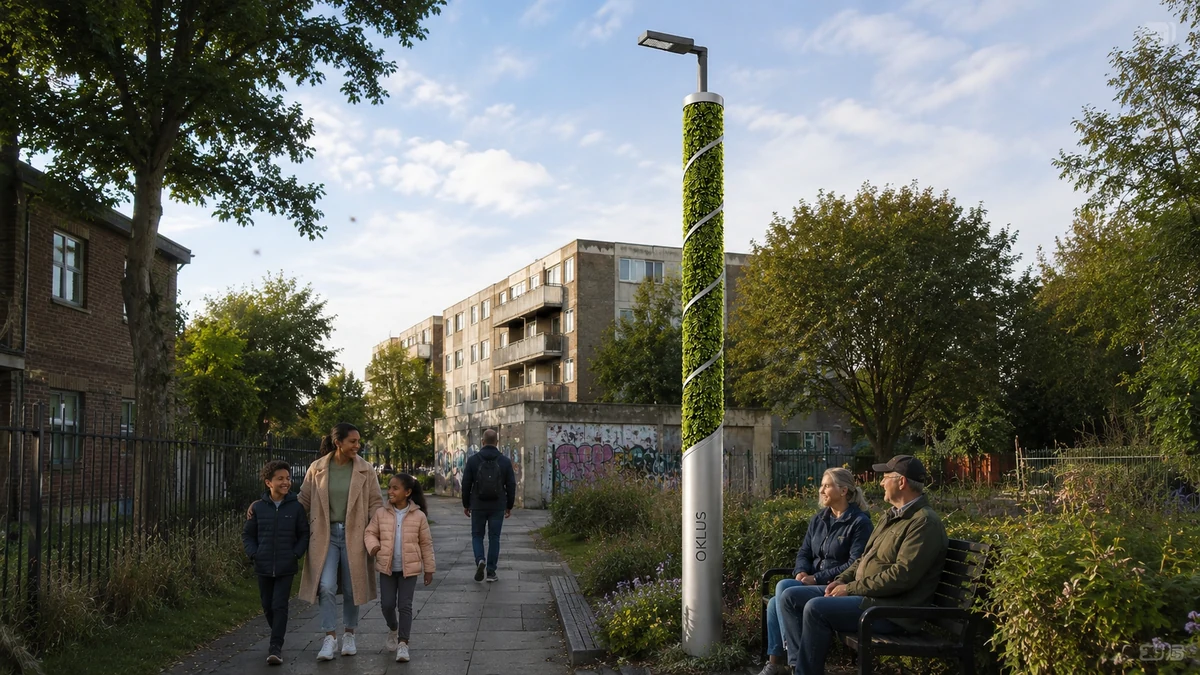
FEATURED INSIGHT
Why visible infrastructure can help communities understand local environmental action.
Designing pilots that are practical, measurable and easy to explain.
Read the insight ↗NEWS & INSIGHTS
Updates on product development, pilot thinking, public-realm design and the partnerships shaping the next stage of OKLUS.
Designing pilots that are practical, measurable and easy to explain.
Read the insight ↗PROGRESS, WITHOUT THE SPIN
This is where OKLUS shares the thinking behind the proposition, not just the finished visuals.
Updates will distinguish between live work, future concepts and evidence still to be gathered. That clarity matters to councils, partners and investors assessing development quality and delivery readiness.
DEVELOPMENT RECORD
As technical work, research and pilot preparation progress, this section will record public milestones without implying partnerships, approvals or results that have not been agreed.
A new public research handover brings together roadside vegetation, vertical greening and moss studies to show why OKLUS is treating cleaner-air performance as a testable engineering question rather than a decorative assumption.
Explore the evidence direction ↗OKLUS is using CityTree as a market precedent for engineered living systems in small urban footprints, while clearly rejecting simplistic tree-equivalent scaling or recycled carbon headlines.
See the research notes ↗The review introduces a measured-microhabitat direction covering cavity temperature, humidity, solar exposure, artificial light, orientation and biological outcomes beyond simple occupancy.
Explore measured microhabitats ↗The Species Recovery Network and Wild Bee Observatory concepts add a species-led route for habitat research, natural colonisation and monitored ecological learning.
Explore species research ↗The new route explores how suitable street-light infrastructure could be considered alongside landscape, ecology, adoption and maintenance before specifications are fixed.
Explore New Developments ↗Published plant science is now being used to shape candidate planting questions, alongside a route-level framework for shade, surface temperature, humidity, solar exposure and airflow.
Explore Living Media ↗The framework sets out the engineering and operational review areas that sit between a product concept and a suitable controlled pilot, without publishing protected construction detail.
Explore Technical Assurance ↗OKLUS RESEARCH NOTES
This developing series starts with external science and external market context, then explains the design question each source creates for OKLUS. The research informs what we test; it is not evidence of OKLUS performance.
The historic CityTree comparison referred to particulate-matter filtering performance, not carbon capture. For OKLUS, the useful lesson is that compact engineered biology can be treated as infrastructure, but the claim itself must not be copied across.
Peer-reviewed roadside studies show that carefully chosen vegetation can capture traffic-derived particulate matter in the right conditions. The job for OKLUS is to test whether those mechanisms can be integrated effectively into a serviceable street-light platform.
Roadside deposition studies suggest that height and breathing-zone position can change what the planting is exposed to. That supports OKLUS treating vertical placement as a design variable, not just a visual decision.
Published studies have found large differences in particulate capture between plant species and leaf traits. That is why candidate OKLUS living-media palettes should be selected against functional criteria rather than generic ornament.
Recent research strengthens the idea that moss can act not only as a biological surface, but also as a physical record of roadside deposition. That opens a future OKLUS question around removable sample cartridges and measured analysis.
Solar exposure and heated surfaces can create conditions that ambient air temperature alone does not describe. That is why future habitat pilots should compare cavity, surface and ambient temperatures.
Research on insect responses to artificial light is pushing OKLUS towards a deliberately dark habitat zone and towards excluding habitat from locations where light spill cannot be managed responsibly.
Cavity-nesting research raises a practical question for an infrastructure-mounted habitat: how do different orientations and shade conditions change the internal microclimate over time?
Research into insect navigation supports testing clear approach space and visually legible entrances rather than treating every visible surface as an opportunity for decorative complexity.
Temperature, radiation, surface conditions, shade, airflow and water balance can interact. The emerging OKLUS approach is to retain that context rather than reduce biodiversity to one sensor value.
The research direction is to connect environmental conditions with investigation, nest establishment, completed brood cells, emergence and reuse where a responsible pilot can observe them.
LATEST THINKING
Designed as a transparent record of development, pilot preparation and the practical questions being worked through with future partners.

A strong pilot begins with the decision it needs to inform. Route relevance, maintenance access, community context and evidence design all need to connect.
Explore route thinking ↗
Why using existing lighting infrastructure can create a more practical path from pilot to portfolio.
View the product ↗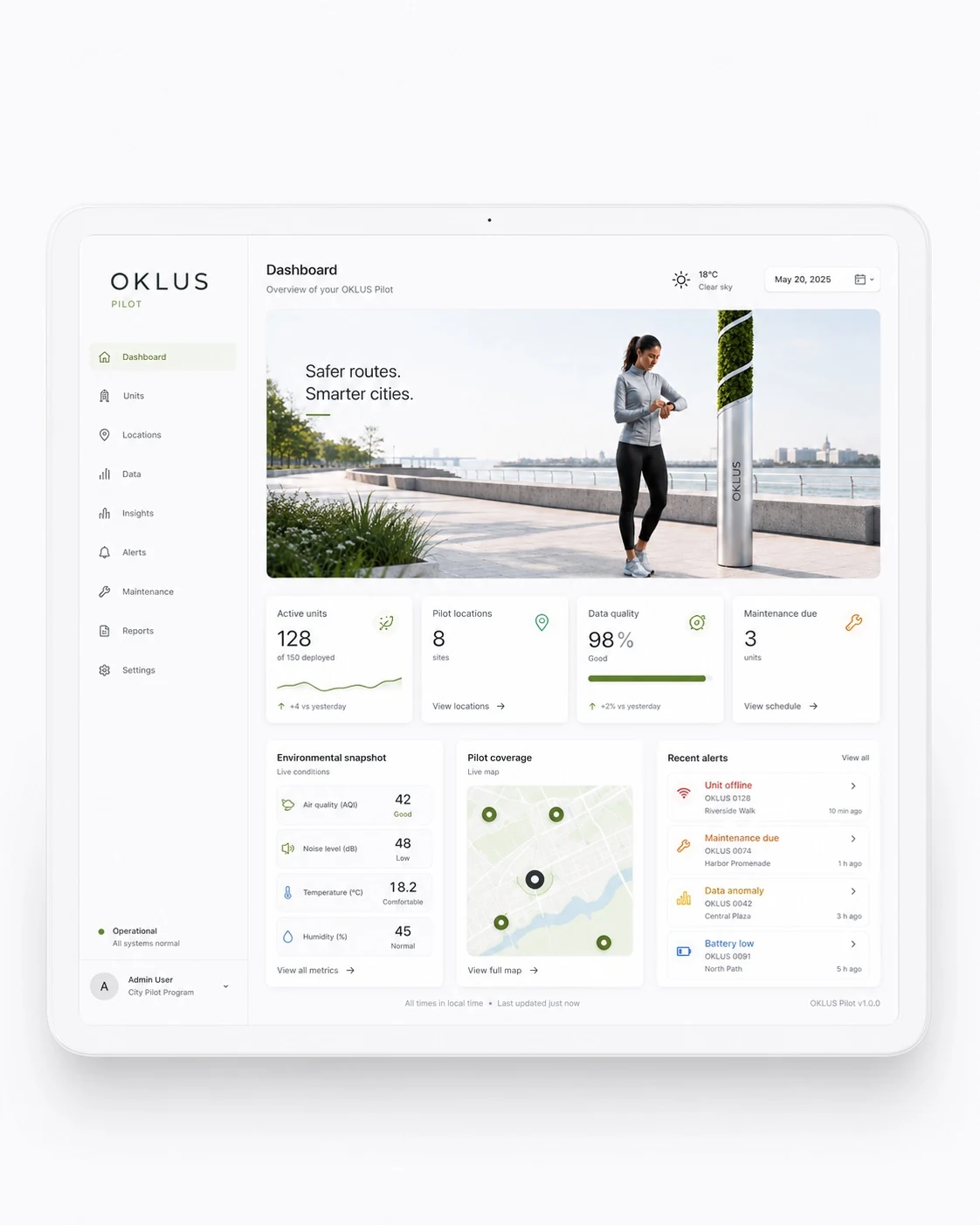
How pilot teams can agree measures, limits and review gates before installation begins.
Explore evidence ↗
Planting, access and service planning must be designed together, not treated as an afterthought.
Explore Living Media ↗
Long-life materials, replaceable sections and clearer recovery routes can support a more credible lifecycle story.
Explore Materials in Motion ↗THE SIGNAL BEHIND THE STORY
A useful update should reveal more than activity. It should show whether the proposition is becoming clearer, more testable and more deliverable.
FOUR PERSPECTIVES
News and insight should help each audience understand the part of the proposition they are responsible for evaluating.
How a pilot serves local priorities, communicates honestly and supports a defensible next decision.
Council perspective ↗How retrofit logic, access, inspection and maintenance can work within existing responsibilities.
Highways perspective ↗How environmental infrastructure can be understandable, useful and connected to everyday routes.
Community perspective ↗How evidence quality, delivery capability and partner alignment reduce uncertainty over time.
Investor conversation ↗STAY CLOSE TO THE WORK
For development updates, pilot conversations and partnership news, connect directly with the OKLUS team.