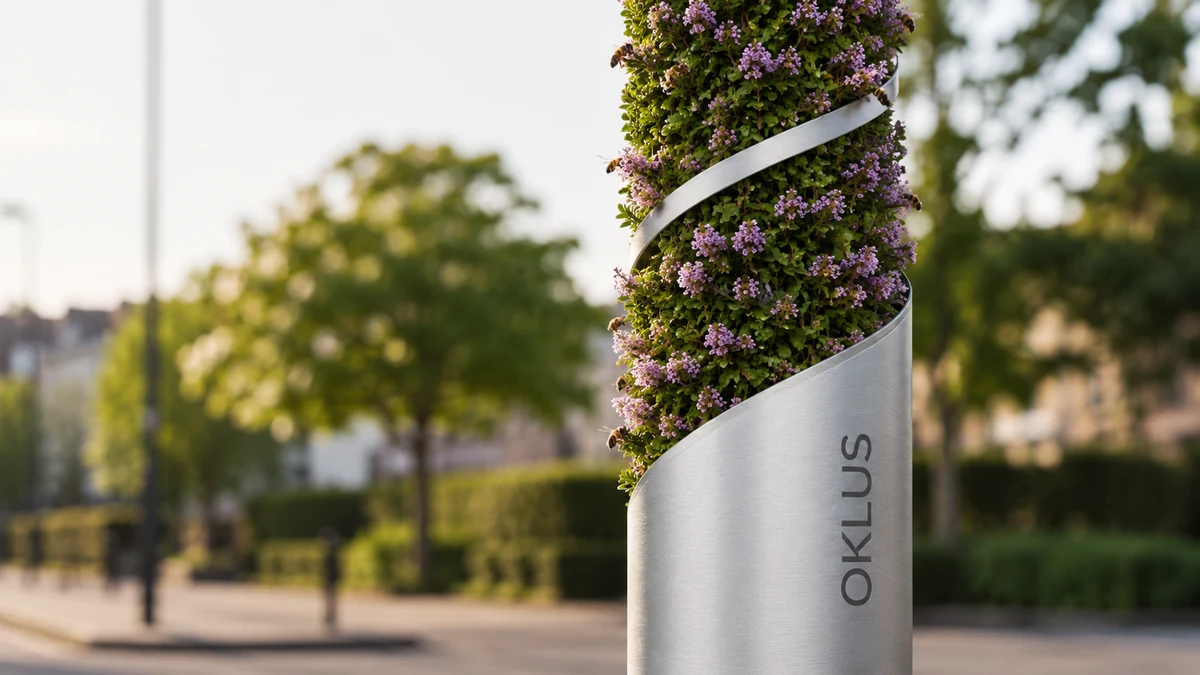
LIVING MEDIA
Biology designed for real streets, real seasons and real care.
OKLUS is developing a serviceable living-media system for suitable street locations, with selection, inspection and replacement treated as part of the infrastructure rather than an afterthought.
THE SYSTEM IS MORE THAN THE PLANTING
A credible living-media proposition connects ecology with engineering. Beautiful by design. Practical by discipline.
Street conditions are demanding. Sun, shade, wind, heat, moisture, pollution, access and maintenance all influence what can perform responsibly.
OKLUS is therefore developing living media as a managed system. The aim is to define suitable plant palettes, media profiles, protection, inspection and renewal pathways that can be tested transparently through structured pilots.

01Living-media zoneLocation-specific palette and managed growing layer
02Protective transitionDefined edge, drainage thinking and service access
03Retrofit bodyDurable public-realm enclosure around a suitable existing column
A SERVICEABLE LAYER
Designed to be inspected, refreshed and improved.
Living infrastructure only remains credible when its care model is as visible as its visual impact.
Site profileSun exposure, shade, wind, urban heat, route use, access and local planting context.
Media profileGrowing medium, moisture strategy, rooting depth, containment and drainage assumptions.
Care profileInspection rhythm, seasonal attention, replacement thresholds and named delivery roles.
Evidence profileCondition records, interventions, survival, appearance and learning across the pilot period.
A MODULAR PALETTE
Different streets need different biological responses.
These illustrative palette studies show the type of curated approach under consideration. Final specifications would depend on route assessment, technical review, maintenance capacity, urban cooling priorities and pilot learning.
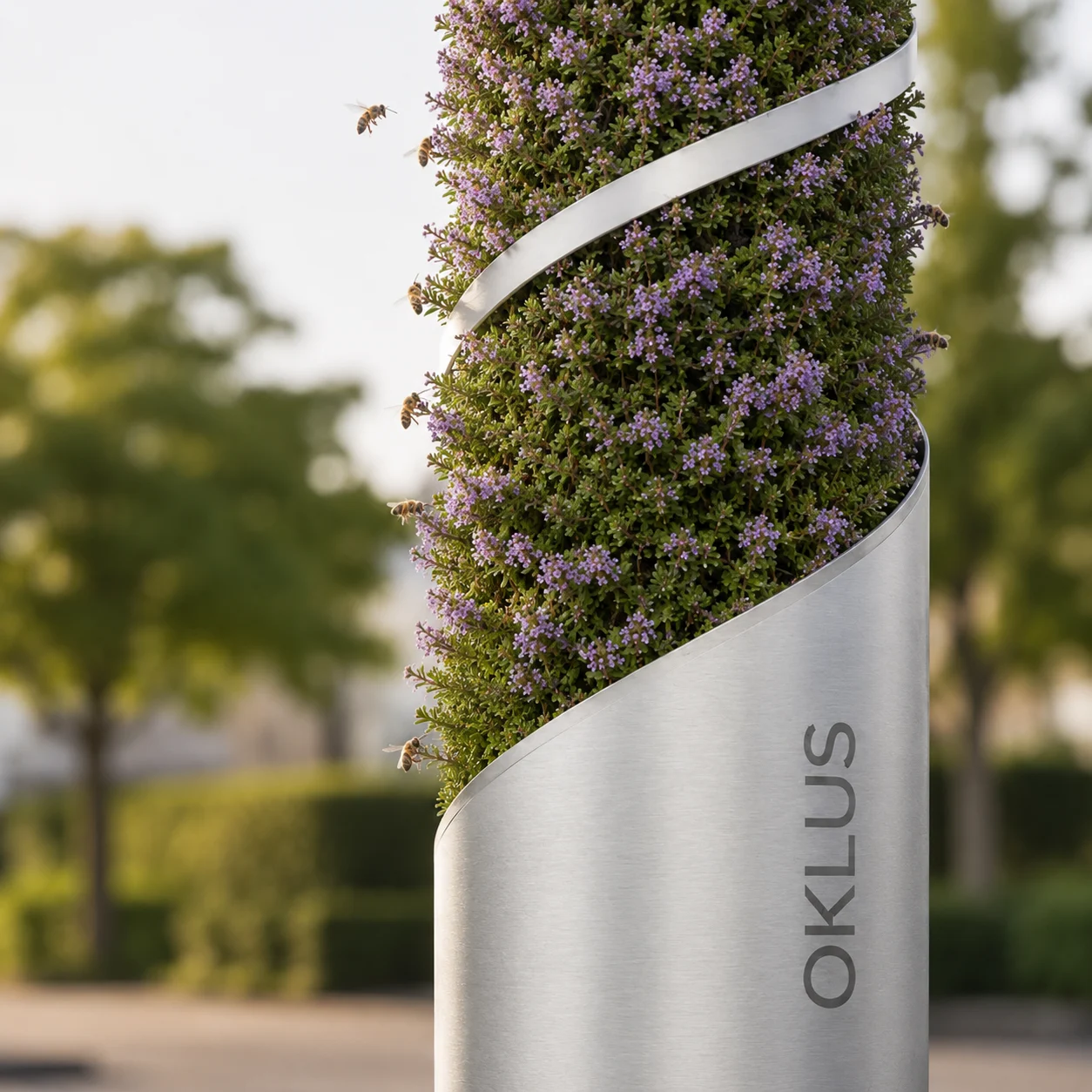
MASTER GUIDE
A common framework for selection, cooling and care.
Bring species choice, route conditions, shade value, servicing and evidence into one shared specification.
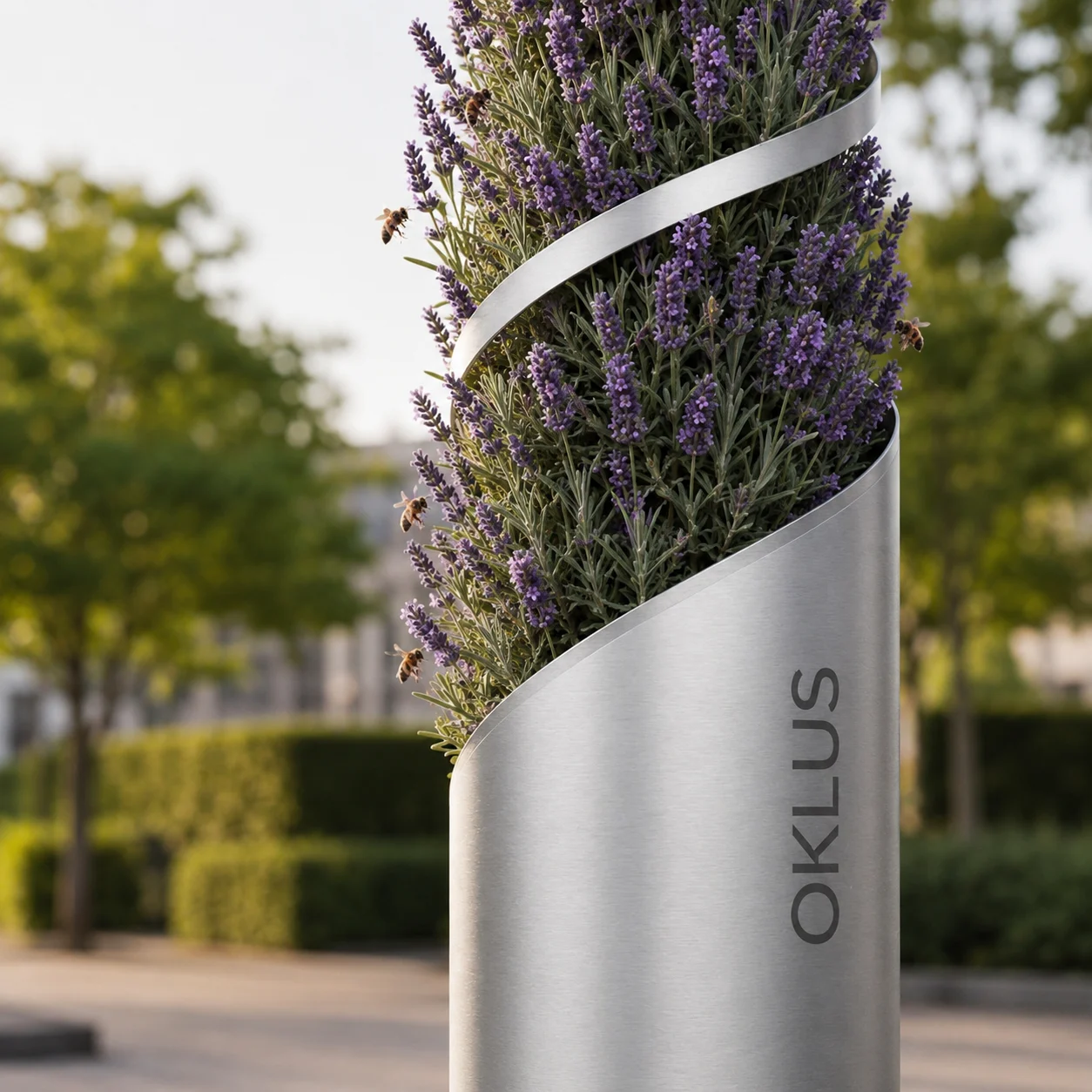
BIO 01
Community and pollinator palette
Illustrative flowering choices for suitable civic, park and community routes.
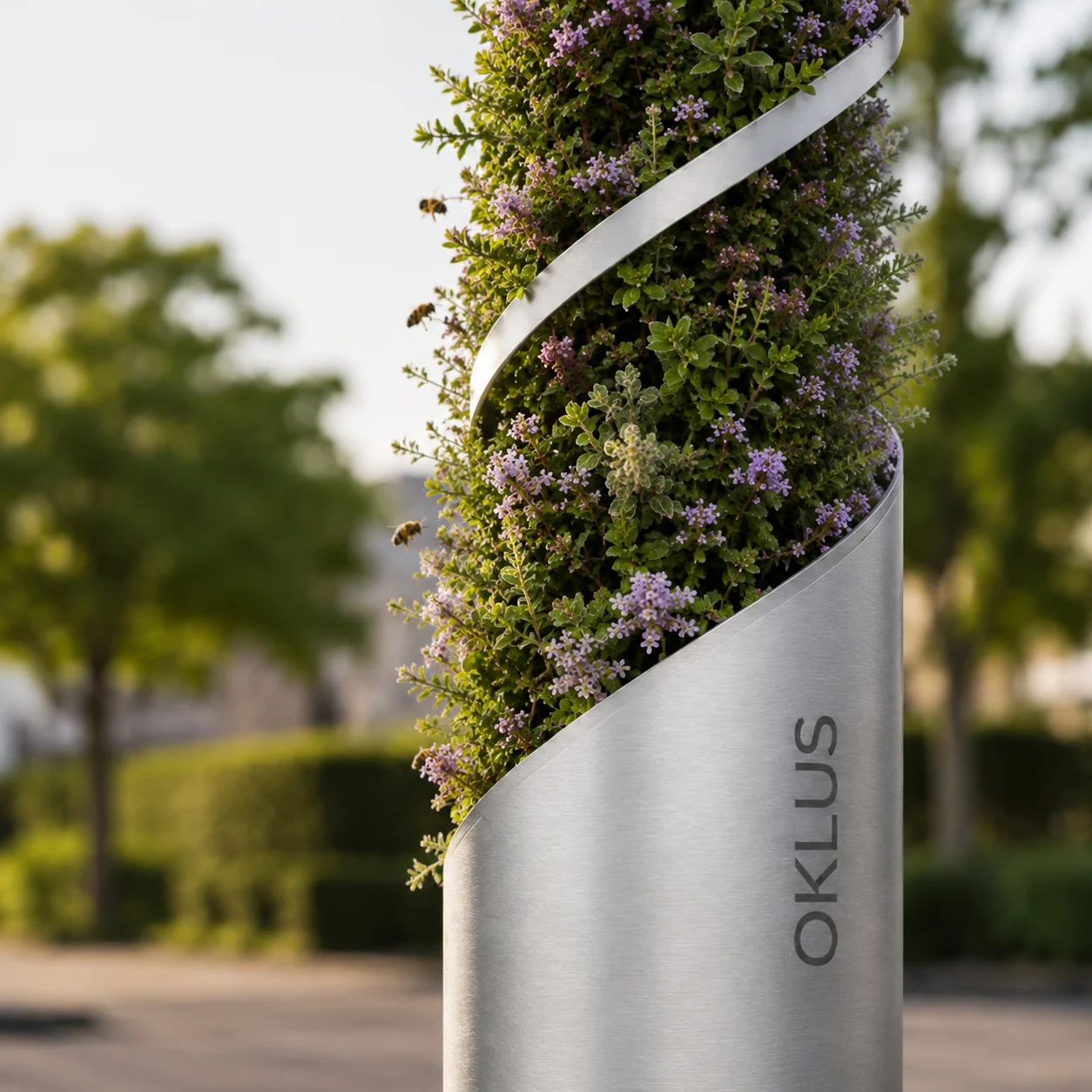
SHADE 01
Lower-light route palette
Species thinking for sheltered, shaded or north-facing positions.

URBAN 01
Urban cooling palette
Hardier options for exposed, warm or higher-footfall locations where visual quality and thermal comfort both matter.
PLANT SCIENCE
Not every leaf performs the same job.
Plant choice within an OKLUS pilot should be based on more than appearance. Published research indicates that canopy density, leaf texture, hairs, surface roughness, plant form, resilience and environmental conditions can influence how vegetation interacts with airborne particulate matter, rainfall, temperature and urban biodiversity.
OKLUS intends to use established plant science to inform candidate palettes, then test those choices under the very different constraints of a compact, serviceable street installation.
Leaf texture matters.
Royal Horticultural Society research has found that large, dense canopies and hairy or rough leaves can perform strongly for particulate capture. In traffic-hotspot hedge research, Cotoneaster franchetii captured around 20% more particulate emissions than several other shrubs studied.
This is external hedge research. It is not evidence that an OKLUS unit removes 20% more pollution.RHS hedges research ↗Species performance varies.
A roadside living-wall study in Stoke-on-Trent compared twenty species and found significant differences in PM1, PM2.5 and PM10 accumulation. Juniperus chinensis recorded particularly high particulate accumulation within that experimental system.
The finding supports research-informed species selection, not an OKLUS performance claim.Peer-reviewed study ↗Capture is only part of the question.
University of Surrey researchers have examined particulate accumulation, wash-off and retention across green-wall species, including how leaf traits and rainfall affect what remains on the plant surface.
For OKLUS, maintenance, rainfall, condition and retention matter alongside initial deposition.University of Surrey / STOTEN 2024 ↗Plants provide more than one function.
Royal Botanic Gardens, Kew highlights the role of urban vegetation in shade, air-quality support, water management and biodiversity, while also emphasising resilience to future climate conditions.
The research question for OKLUS is whether carefully selected living media can provide useful complementary functions where larger-scale greening is constrained.Royal Botanic Gardens, Kew ↗Could leaf form or surface characteristics support particulate interception?
Can the species tolerate the relevant sun, shade, wind, heat and roadside environment?
Can the planting provide useful pollen, nectar, shelter or other ecological value where appropriate?
Could evapotranspiration, shading or surface interaction contribute to the wider microclimate research question?
Can the plant be inspected, maintained and replaced within a practical infrastructure maintenance regime?
Right plant. Right place. Right evidence.
OKLUS does not assume that one planting palette will work everywhere. Pilot specifications should consider local ecology, climate, exposure, maintenance capacity, public-realm requirements and the environmental question being investigated. Candidate species may change as engineering development, horticultural advice and pilot evidence improve the specification.
From controlled experiments to real streets NASA study, in context
NASA research published in 1989 examined the ability of plant leaves, roots, growing media and associated microorganisms to remove selected volatile organic compounds from air in controlled indoor environments. The work became widely associated with “air-purifying plants”.
Subsequent analysis has shown that results from small sealed chambers should not be treated as evidence that ordinary potted plants materially clean real occupied spaces. OKLUS is therefore not relying on historic indoor plant claims. Candidate living-media functions will be assessed against relevant outdoor research and, where appropriate, measured through controlled real-world pilots.
NASA Technical Reports Server, 1989 ↗Cummings & Waring, 2020 ↗
URBAN COOLING AND MICROCLIMATE
Explore the route, not just the air temperature.
Future OKLUS Cooler Routes research could examine how shade, radiant heat, surface temperature, humidity, solar exposure and airflow shape pedestrian thermal comfort.
A planted OKLUS sleeve is not a replacement for mature tree canopy. The research opportunity is to understand whether measured, serviceable interventions and route-level data can complement wider greening and shade strategies.
Where are the route gaps?
Map when and where pedestrians are exposed to direct sun and where existing shade already performs well.
What is radiating heat?
Compare surrounding surface conditions rather than relying on air temperature alone.
How does the route actually feel?
Consider humidity, airflow, solar exposure and thermal-comfort indicators alongside conventional temperature readings.
What should happen next?
Use pilot evidence to inform planting, shade, maintenance and complementary public-realm interventions.
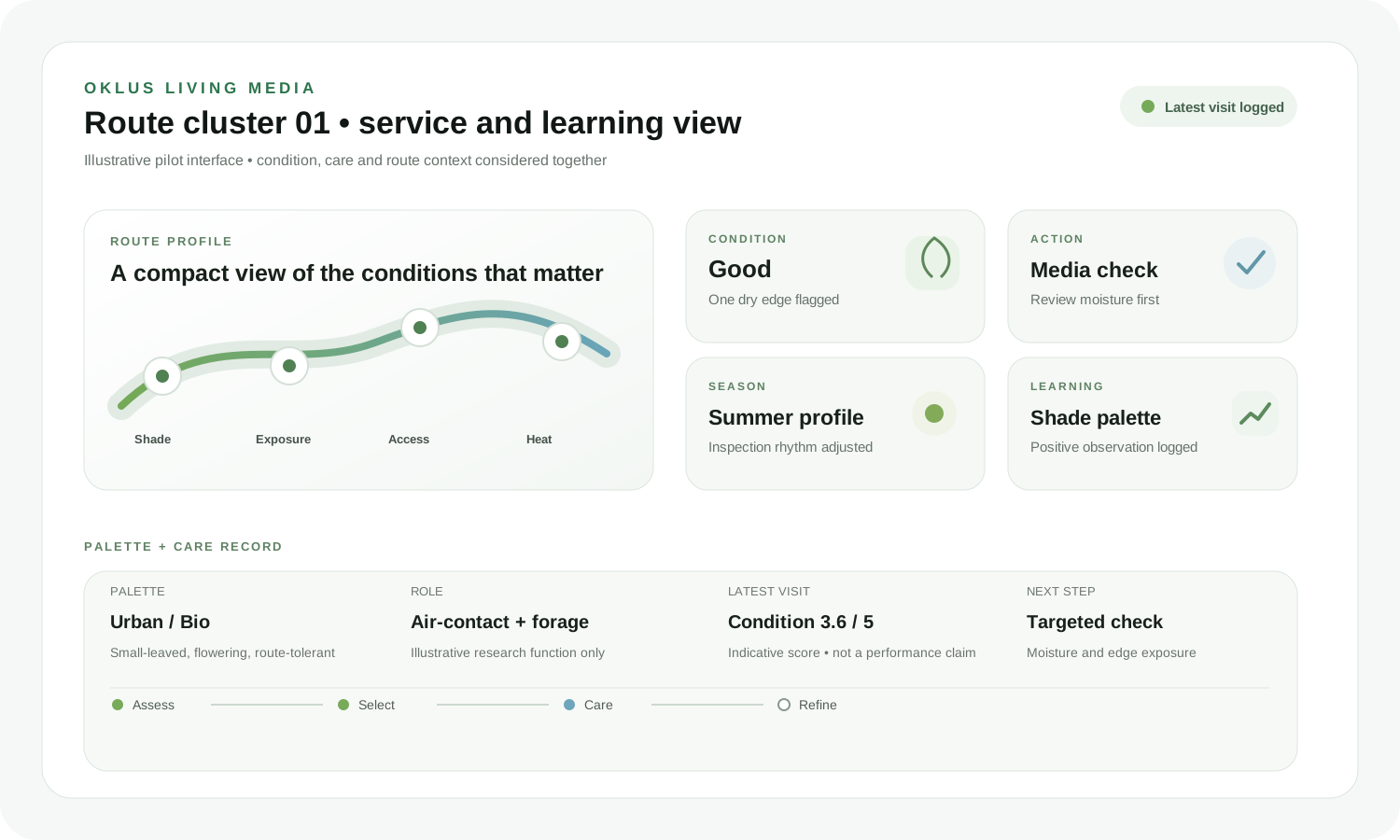
FUTURE CARE-SUPPORT CONCEPT
Turn every visit into a better operating record.
This illustrative interface shows how a delivery team could connect unit condition, care actions, photographic records and seasonal learning. It is a future concept, not a live product claim.
LIVING MEDIA SERVICE VIEWRoute cluster 01
Illustrative pilot interface
A SIX-STAGE LIVING-MEDIA PILOT
Move from attractive concept to repeatable service model.
The pilot should test the complete system, including suitability, installation, care, evidence and the decisions required before any wider use.
Understand the route
Document exposure, access, urban conditions, planned works and maintenance constraints.
Choose the media system
Agree a transparent palette, growing layer, protection and care assumptions for the pilot.
Plan safe delivery
Confirm unit configuration, installation method, servicing access and named responsibilities.
Care to an agreed rhythm
Inspect condition, record interventions and respond to weather, damage or performance issues.
Review the full record
Consider survival, appearance, care time, replacement, cost, public response and route fit.
Improve the next specification
Keep what worked, change what did not and define where the system should or should not be used.
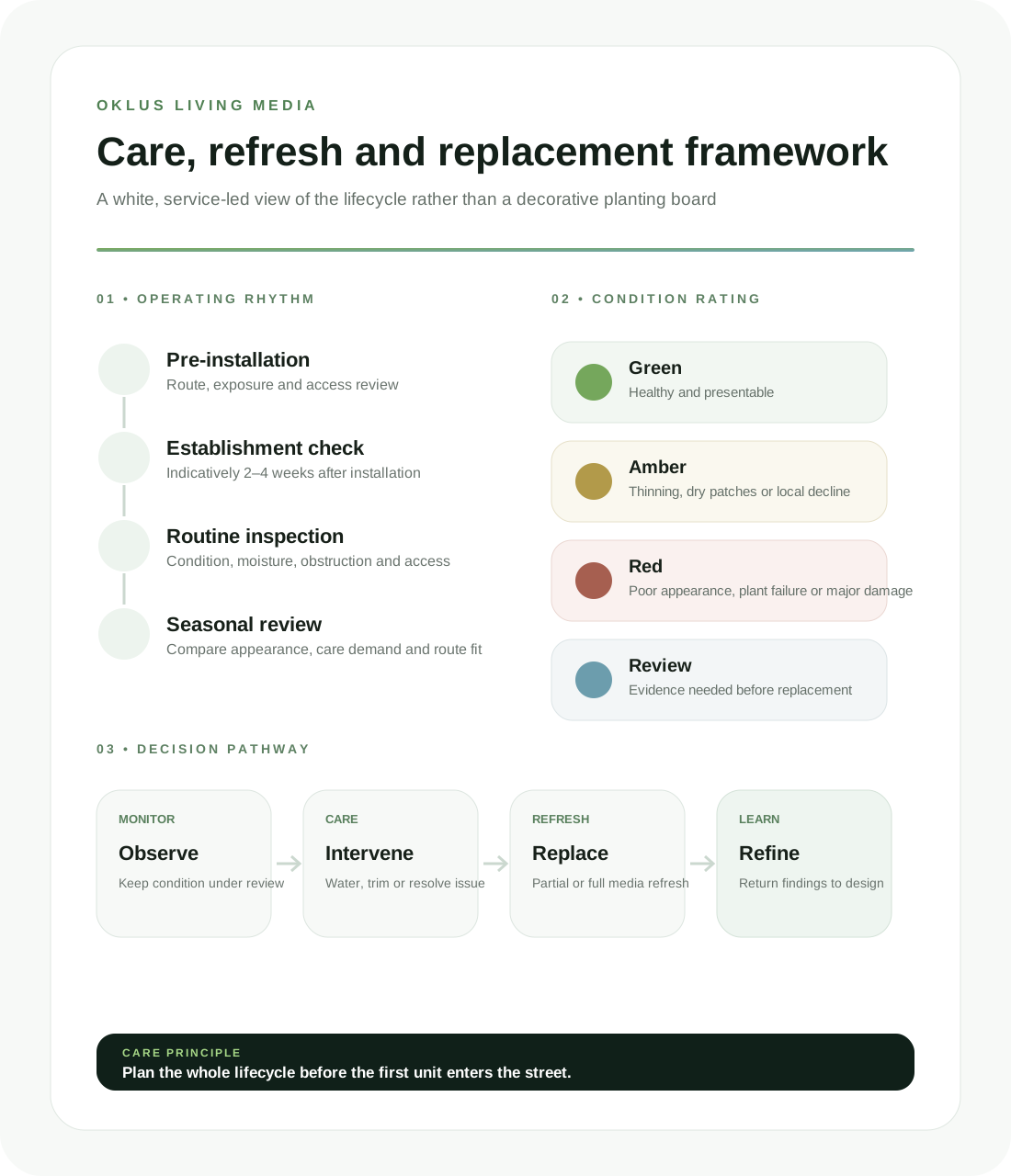
CARE IS PART OF THE PRODUCT
A managed refresh pathway protects quality and confidence.
A living system will change. The important question is whether that change can be understood, cared for and acted on responsibly.
Named checks for condition, moisture, damage, obstruction and access.
Agree when to monitor, care, partially replace or fully refresh the media.
Connect actions and outcomes so the next decision is based on evidence.
Consider reusable components, media handling and practical end-of-cycle pathways.
WHAT THE PILOT CAN REVEAL
Living media can test the strength of the wider OKLUS proposition.
For councils, partners and investors, the value is not a single planting image. It is evidence about whether biology, product, servicing and public-realm delivery can work as one repeatable system.
Where can the system work responsibly?
Identify route types, exposures and operating conditions that support a credible proposition.
Can care be delivered consistently?
Test visit time, access, partner capability, replacement needs and the clarity of responsibilities.
Does the visual standard remain strong?
Understand seasonal appearance, resilience and the thresholds needed to protect public confidence.
Can learning become a specification?
Turn observations into clearer palettes, care protocols, route criteria and commercial assumptions.

BIOLOGY WITH A DELIVERY DISCIPLINE
“The premium finish is not just how it looks on day one. It is how well the system is cared for over time.”
DEVELOPMENT STATUS
Clear about what is designed, what is proposed and what still needs testing.
OKLUS Living Media is a developing system concept. Final species, media, irrigation or moisture approaches, service intervals, partners, costs and outcomes require technical work and structured pilot evaluation.
Current propositionA curated, serviceable living-media layer designed to integrate with suitable OKLUS retrofit configurations.
Pilot purposeTest route suitability, palette choice, care effort, replacement pathways, appearance and operational learning.
Not a current claimNo guaranteed air-quality, biodiversity, cooling or wellbeing outcome is presented before independent evaluation.
Next decisionSelect a technically suitable route and agree the living-media specification, care plan and evidence method with delivery partners.